Project overview
Since opening in March 2022, the First Voluntary Surgical Hospital (FVSH) in Ivano-Frankivsk has provided life-changing reconstructive surgery and rehabilitation services to wounded soldiers across Ukraine. However, with only 14 beds and limited rehabilitation space, demand significantly exceeded the hospital’s capacity, restricting the number of patients who could access treatment and limiting opportunities for long-term sustainability.
Archus partnered with Floyd Slaski Architects and local stakeholders to develop a comprehensive feasibility study and clinical brief for the hospital’s expansion. The objective was not only to increase capacity but also to create a resilient healthcare facility capable of supporting both wartime and peacetime healthcare needs.
Working closely with clinicians, hospital leaders and veteran support organisations, we undertook service planning, stakeholder engagement and operational analysis to define a future model of care centred on holistic recovery. Our work included mapping current and future patient pathways, developing a schedule of accommodation for a new rehabilitation facility and creating clinical and functional requirements aligned with international best practice.
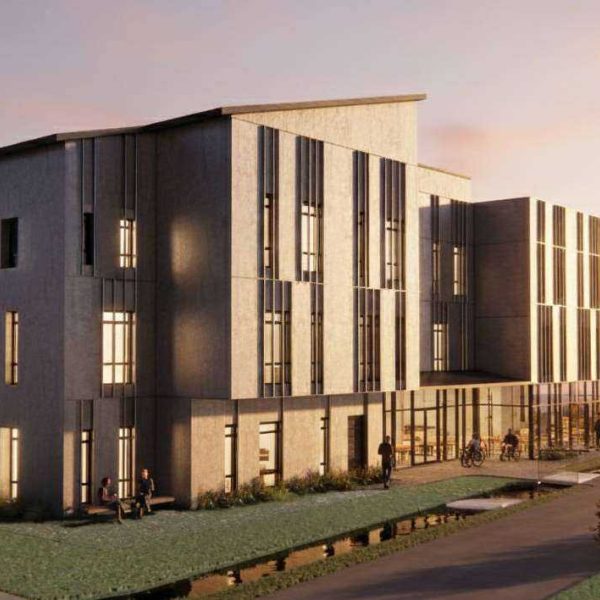
The resulting proposal supports an increase in capacity from 14 to 54 beds, including dedicated rehabilitation, mental health and outpatient facilities. By combining strategic healthcare planning with adaptable design principles, the project creates a blueprint for sustainable healthcare delivery that can continue supporting Ukraine’s recovery long after the immediate impacts of conflict have subsided.
Outcomes
- Developed a comprehensive feasibility study and clinical brief supporting sustainable hospital expansion.
- Increased planned capacity from 14 to 54 beds, enabling treatment for approximately 750 patients per year.
- Created a future-proof healthcare model capable of adapting to both wartime pressures and peacetime service delivery.
The challenge
FVSH was experiencing sustained demand for complex reconstructive surgery and rehabilitation services from injured service personnel across Ukraine. While the clinical team could perform multiple complex procedures each day, limited recovery and rehabilitation space constrained throughput and prevented the organisation from meeting growing demand. The hospital also faced challenges in securing long-term funding due to its small scale. Any expansion needed to increase capacity quickly while balancing resilience, affordability and adaptability in an uncertain healthcare environment shaped by both current conflict and future recovery needs.
The solution
Archus worked alongside Floyd Slaski Architects to create a strategic plan for expansion that integrated healthcare planning, operational analysis and facility design. Through collaborative workshops and stakeholder engagement, we mapped patient pathways, identified service pressures and translated operational requirements into a detailed clinical brief and schedule of accommodation. The proposed solution introduced a dual operating model that supports intensive inpatient rehabilitation during periods of conflict while enabling a transition to community-focused, outpatient and technology-enabled services in peacetime. The design incorporated rehabilitation wards, mental health services, outpatient facilities and flexible infrastructure capable of adapting to future healthcare demands.
The impact
The project provides FVSH with a clear roadmap for sustainable growth and long-term resilience. By increasing treatment capacity and creating structured rehabilitation pathways, the proposed facility will relieve pressure on frontline stabilisation units and regional hospitals while supporting more comprehensive patient recovery. The development also positions the organisation to access sustainable funding opportunities and serves as an exemplar for the future rebuilding of healthcare infrastructure across Ukraine. Most importantly, it creates a model of care that treats the whole person, integrating surgical recovery, physical rehabilitation, mental health support and community reintegration within a single coordinated service.

